Fishing logbook guide
Dam Tailwater Fishing: What a Summer Catfish Trip Taught Me About Bank Fishing
A summer bank fishing trip below a dam shows how current, live bait, drop nets, timing, noise, and fishing notes can turn a casual outing into a useful fishing log.
Some fishing trips are about the catch. This one was about the current, the company, and a little Chihuahua riding in a wagon. I spent a hot summer afternoon bank fishing below a dam, casting from a ledge about twelve feet above the water while my friend Joe pulled channel catfish out of the tailwater like he had done it a thousand times. He probably has.
I got skunked. Joe did not. And I still walked away with a cooler that held one catfish, a phone full of photos, and a handful of bank fishing lessons worth writing down. That is the thing about a good day on the water. Even when the fish ignore you, the water is still teaching.
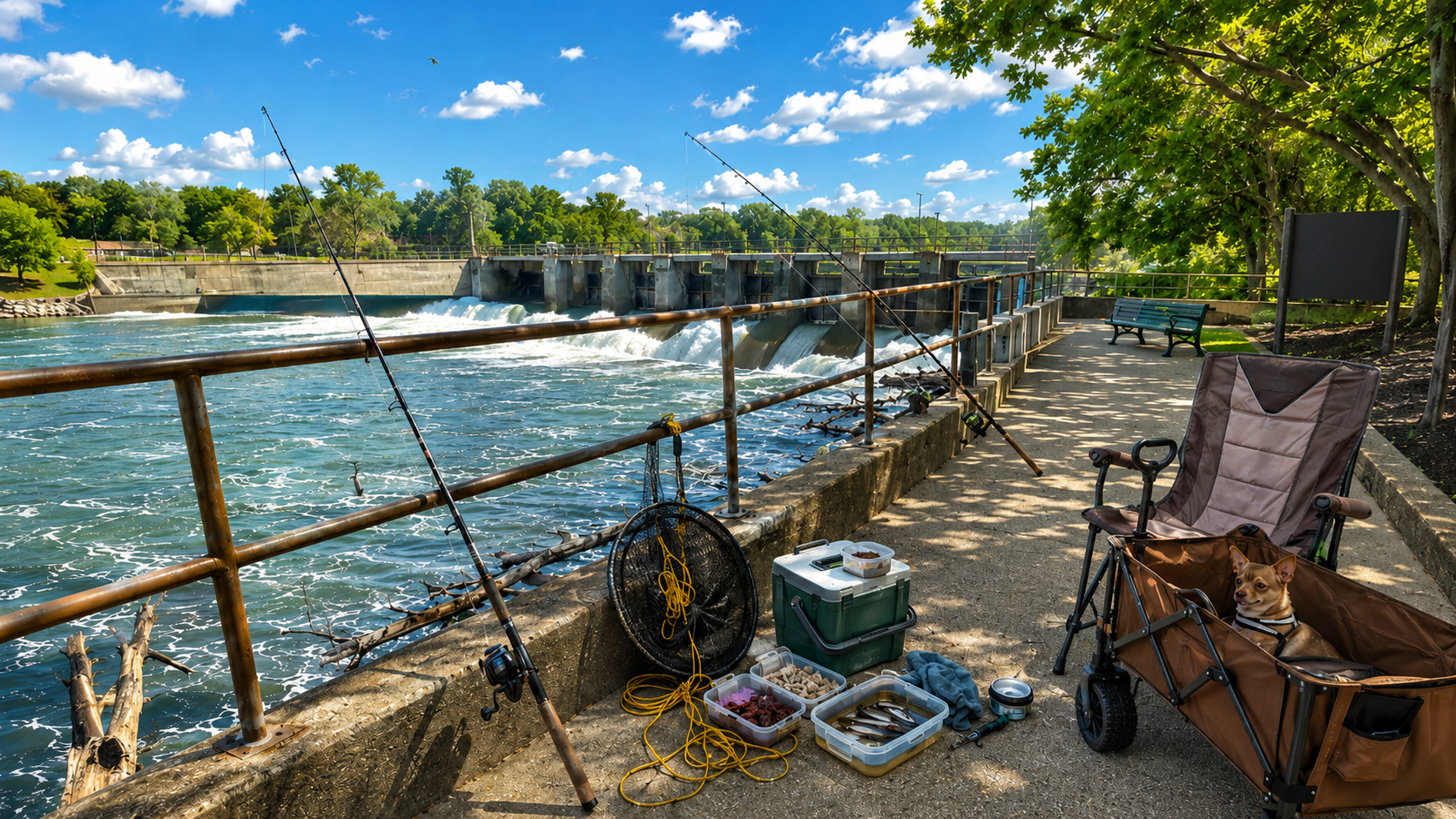
A summer afternoon below the dam
We fished from a public riverfront spot below a dam, right where the whitewater churned, pushed oxygen back into the river, and created the kind of current seams that make anglers stop and pay attention. It was hot and sunny, the kind of summer afternoon where the sun sits on your neck and the shade under the trees feels like a reward. We started around 3 PM and planned to fish into the evening.
Our spot was a high ledge near the tail end of the dam, about twelve feet above the surface. There was a bench nearby, so we set up chairs, staged our rods, and settled in. Birds were working the water constantly, diving and wheeling over the current, which is usually a good sign that baitfish are around. When we walked up, another angler on the far end had already pulled a big flathead catfish out of the water. Nothing gets you fishing faster than watching someone else land one before you have even baited a hook.
The setup: high bank, dam current, and a few hours to fish
Bank fishing below a dam is different from fishing a calm lake shoreline. You are dealing with moving water, uneven footing, snags, current, and in our case, a serious drop from where we stood to where our baits landed. That twelve-foot ledge shaped almost every decision we made, from how we cast to how we planned to land a fish.
Here is what I brought:
- A cooler packed with ice
- Shrimp and chicken liver for bait
- An Ugly Stik, my go-to for anything that fights
- A swivel, an inline spinner, and a sliding Carolina rig to fish the bottom
Joe brought the things that actually mattered that day: live shiner bait, a bottom setup he likes to fish tight to the dam, a drop net for hauling fish up the ledge, and his dog, a tiny Chihuahua that spent most of the afternoon looking unimpressed by all of it.
We had about three hours of good fishing time ahead of us and a stretch of tailwater that Joe knows far better than I do.
Why dam tailwaters are worth logging
If you are new to river fishing, dams and tailwaters are some of the highest-percentage spots you can find. There are a few reasons places like this hold fish, and every one of them is a reason to write the spot down in your fishing log.
First, moving water over a dam pulls oxygen into the river. On a hot summer day, when warm water can become less comfortable for fish, oxygenated tailwater can act like a magnet. Second, current concentrates food. Baitfish, insects, and anything swept downstream often funnel through predictable lanes below the dam. Third, the churning water creates current seams, the visible edges where fast water meets slower water. Catfish, bass, and other predators often sit near those seams so they can conserve energy while food comes to them.
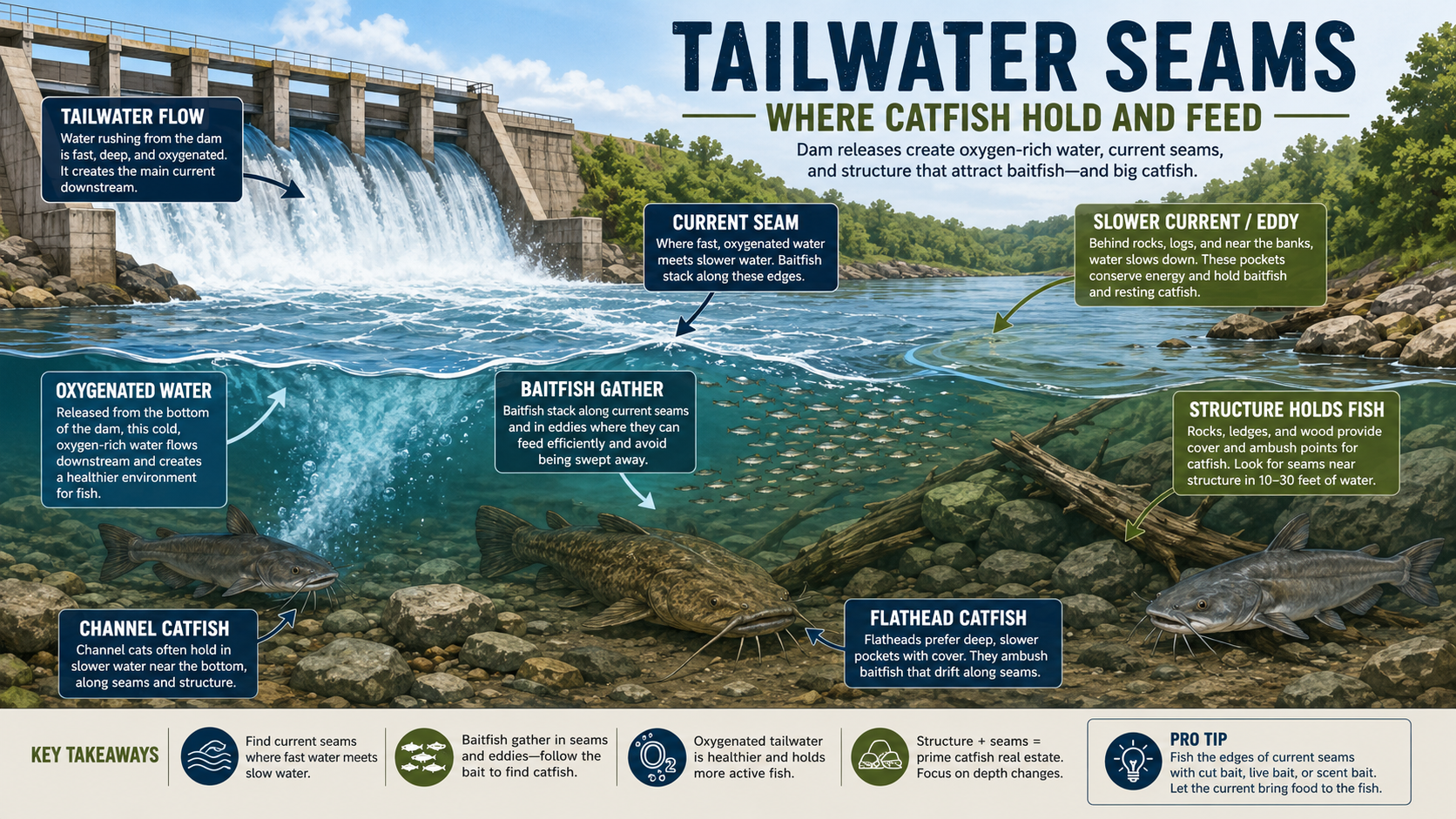
Add in structure, the dam face, submerged rocks, driftwood along the banks, and you have oxygen, food, current breaks, and cover all stacked in one place. That is why certain tailwater spots produce year after year, and why it is worth recording exactly where the fish came from when you catch one.
Joe’s local knowledge and why experience matters
Joe has fished this spot for about twenty years. Two decades of casting into the same tailwater teaches you things no app or article can. He knew where the fish would sit on a hot afternoon, how tight to the dam to put his bait, and what the shiners needed to do to draw a bite. Fishing that ledge on a blistering summer day is his forte, and it showed.
Local knowledge is one of the most underrated advantages in fishing. Someone who has fished a spot for years has, in effect, been keeping a fishing log in their head. They remember which conditions produced, which ones did not, where the snags are, where the fish hold, and when the bite tends to turn on.
The rest of us can build that same knowledge faster by actually writing it down. That is really the whole idea behind a fishing journal. It turns scattered trips into a pattern you can read.
I have written before about how a no-catch trip at a local church lake still sharpened the way I read water. Fishing next to Joe was the same lesson from the other direction. Experience is just logged trips, whether the log lives in your head or in your pocket.
Our bait and rigs: live shiners, shrimp, and a Carolina rig
This is where the day really split in two.
Joe fished live shiners on the bottom, tight to the dam. I am not completely sure how he hooked them to keep them alive and wriggling, that is part of his twenty years of practice, but the principle is one every catfish angler should understand: live bait presentation matters because movement attracts fish. A shiner that is still swimming, flashing, and struggling sends out vibration and visual cues that a chunk of cut bait cannot.
In current, near a dam, where channel cats are hunting actively, that living, moving target can be the difference between a slow rod and a bent one.
I went a different route. I ran a sliding Carolina rig with shrimp and chicken liver to fish the bottom, letting the sinker slide so a fish could pick up the bait without feeling immediate resistance. It is a solid catfish rig and it has produced for me before. Just not this day.
I also kept a rod rigged with an inline spinner and a swivel so I could work some moving water when I got restless.
Both approaches were reasonable. But there is a real lesson in the contrast: live shiners outfished my prepared baits in this spot, on this day, under these conditions. That is exactly the kind of head-to-head comparison that is easy to forget by next week unless you record it.
Fishing from twelve feet up: why the drop net mattered
Here is a problem people do not think about until they are staring down at a fish they cannot reach. When you are on a ledge twelve feet above the water, hooking a catfish is only half the battle. Lifting a twenty-inch channel cat straight up on your line risks pulling the hook, snapping your leader, or dropping the fish back into the river right at the worst moment.
That is where Joe’s drop net earned its spot in the gear pile.
When he hooked up, my friend and I got to work the net, lowering it down on a rope, guiding the fish over it, and hauling it up the ledge. It turned a sketchy, fish-losing situation into a clean landing every time.
If you fish high banks, bridges, piers, or dam ledges, a drop net is not optional gear. It can be the difference between landing fish and telling stories about the ones that came off. It is a small, specific detail, but it is exactly the kind of thing worth noting for a spot so you remember to bring it next time.
What Joe’s two channel catfish taught us
Joe landed two channel catfish, both around twenty inches, both on live shiners fished on the bottom near the dam. I did not catch a thing. I kept one of the channel cats and set it on ice in the cooler to take home.
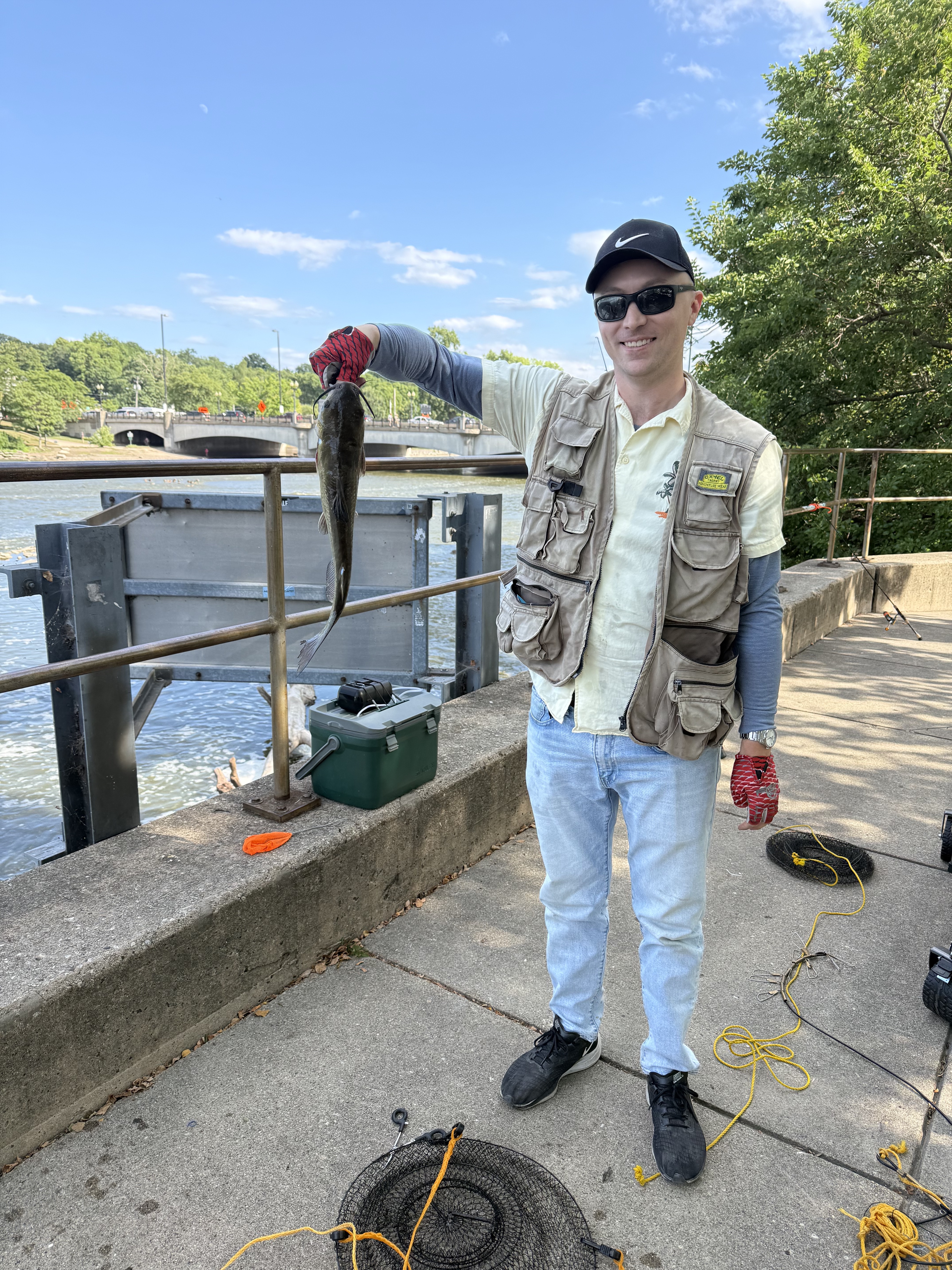
Those two fish told a clear story. On a hot, sunny afternoon, when a lot of anglers assume the bite is dead, catfish were still active in the oxygenated, moving water below the dam. The heat did not shut them down. It just concentrated them where conditions were more comfortable.
The winning presentation was live, moving bait on the bottom, placed in the right water by someone who knew the spot.
Summer catfish fishing near a dam rewards this kind of specificity. Right water, right bait, right spot. Get all three lined up and the temperature matters less than people think.
What I tried with the inline spinner
While Joe worked his bottom rig, I spent part of the afternoon walking an inline spinner near the head of the dam, casting around shaded banks and driftwood. Inline spinners are great searching lures. The blade throws off flash and vibration that predatory fish can pick up in moving or stained water, and they let you cover a lot of ground quickly.
My thinking was reasonable: shade and driftwood are classic ambush cover, and a flashy spinner swung through current seams can draw reaction strikes from bass and other river fish.
It just did not connect that day. That happens.
A searching lure is a bet on covering water to find active fish, and sometimes the fish are not where you are searching. It still counts as information. Now I know that stretch did not produce for me on a hot afternoon, and I know where to try earlier or later next time.
A relaxed, vacation-style day on the water
Not everything about this trip was strategy. A lot of it was just a good summer day outside.
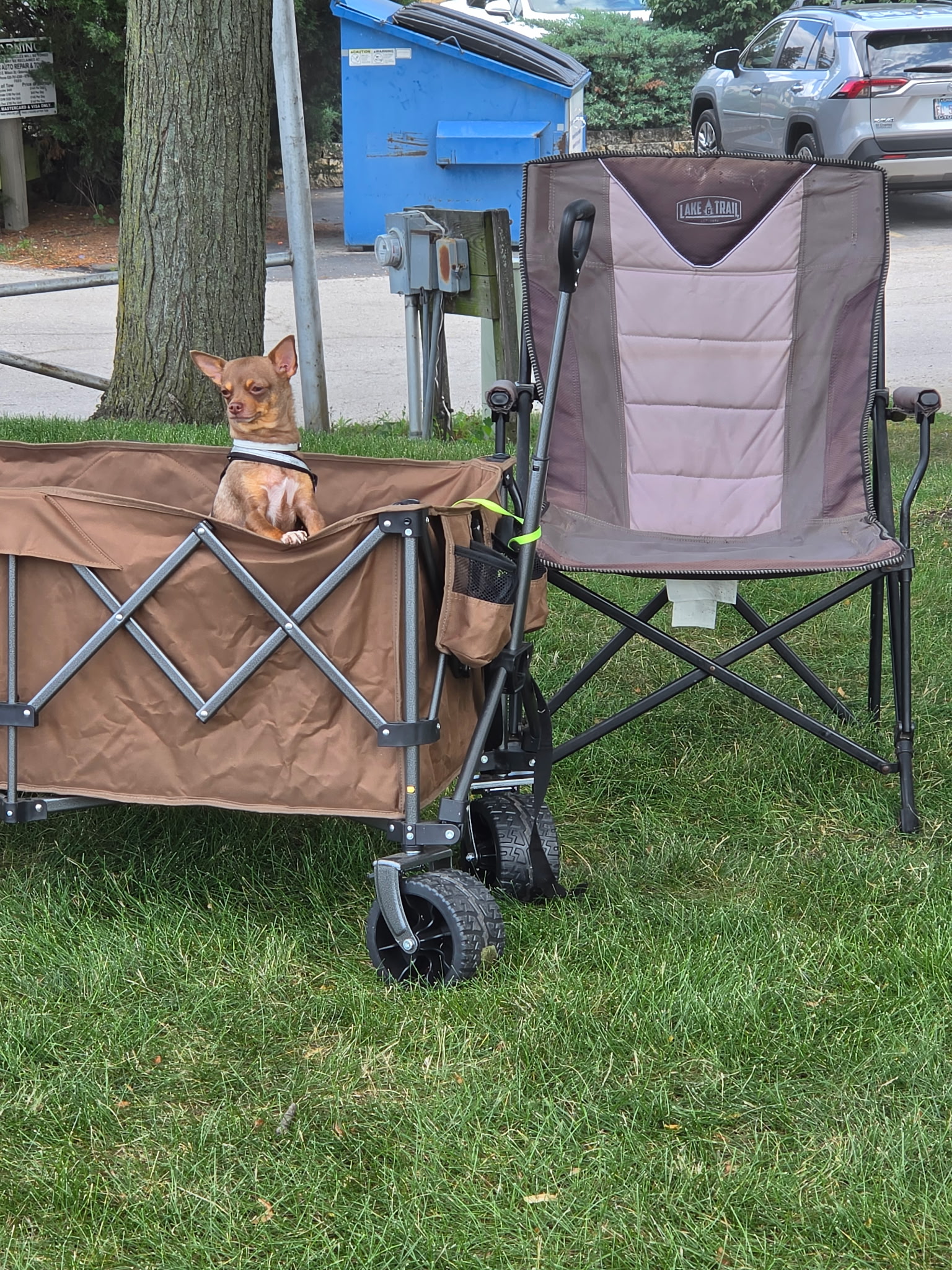
Joe’s Chihuahua rode along in a wagon beside our chairs, keeping watch over the operation. My friend spent part of the afternoon taking photos with the little dog, who was very willing to pose. Between casts there was shade, cold drinks in the cooler, birds working the water, and the steady white noise of the dam. It had the easy, unhurried feel of a day trip more than a serious fishing mission.
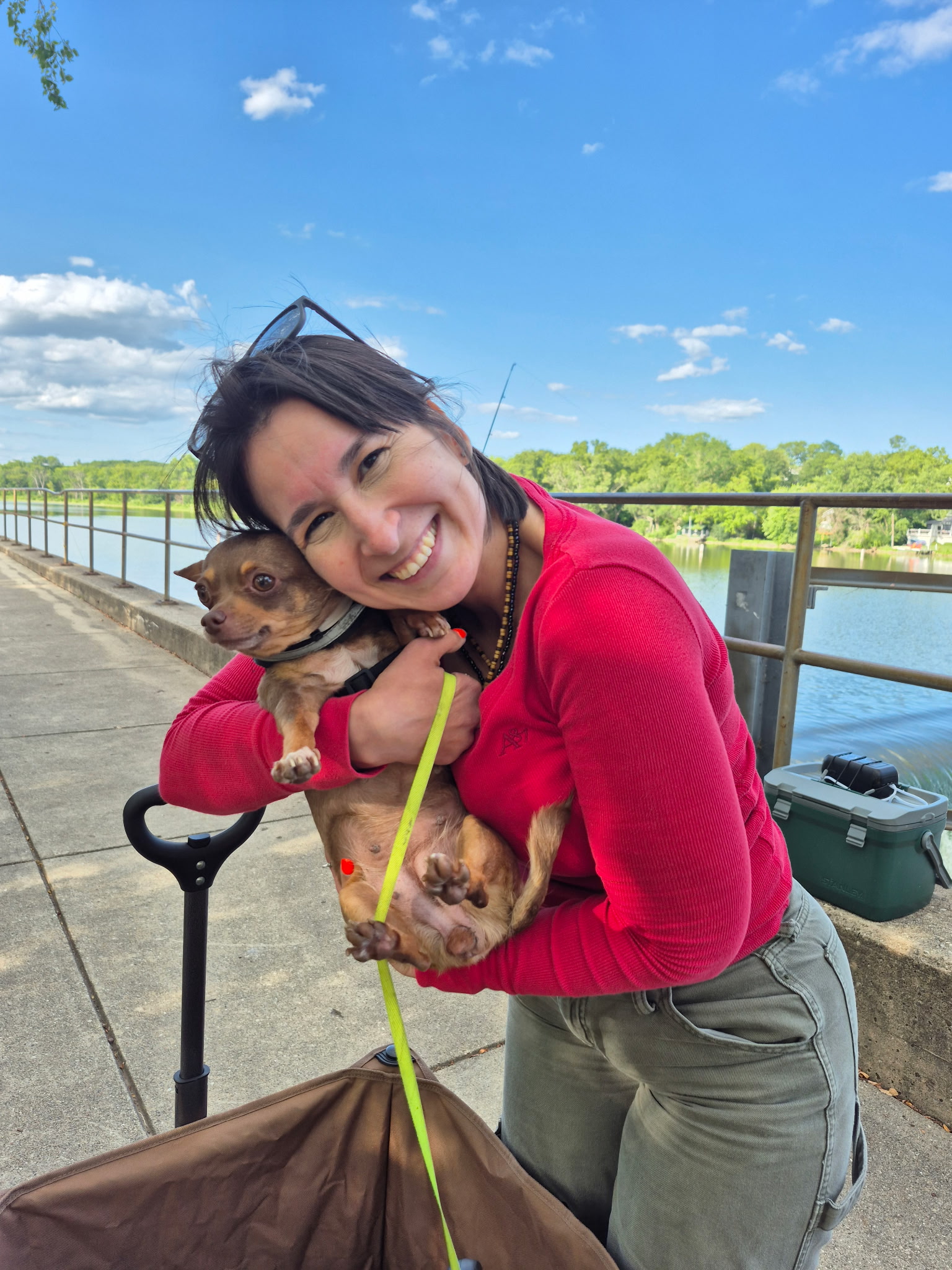
There is something to be said for that. Fishing gives you a reason to be outside with people you like, doing something with your hands while the conversation wanders. The catch is a bonus. The afternoon is the point.
How noise from a nearby festival seemed to change the bite
Around 6 PM, music from a nearby local festival started carrying across the water. Not long after, the bite that had been steady for Joe seemed to slow down, and we wrapped up around then.
I want to be careful here, because it is easy to draw a straight line that may not exist. I cannot prove the music scared the fish. But it is plausible that low-frequency vibration from a stage, carrying through the ground and into the water, changed the mood along that stretch. Fish are sensitive to vibration through their lateral line, and a sudden new source of bass-heavy thumping is not part of their normal environment.
Whether it spooked them, moved them, or just coincided with the natural evening slowdown, I genuinely do not know.
And that is exactly why it is worth writing down. If I fish a similar spot again during a loud event and the bite dies at the same time, that is a pattern. One observation is a guess. Two or three logged observations start to become knowledge.
The small details worth recording in CatchLedger
Here is the honest problem: a week from now, I will not remember whether Joe’s fish came closer to 4 PM or 5 PM, whether the music started before or after the bite slowed, or exactly where along the ledge the drop net came in handy. Memory blurs the specifics fast, and the specifics are what make a fishing log useful.
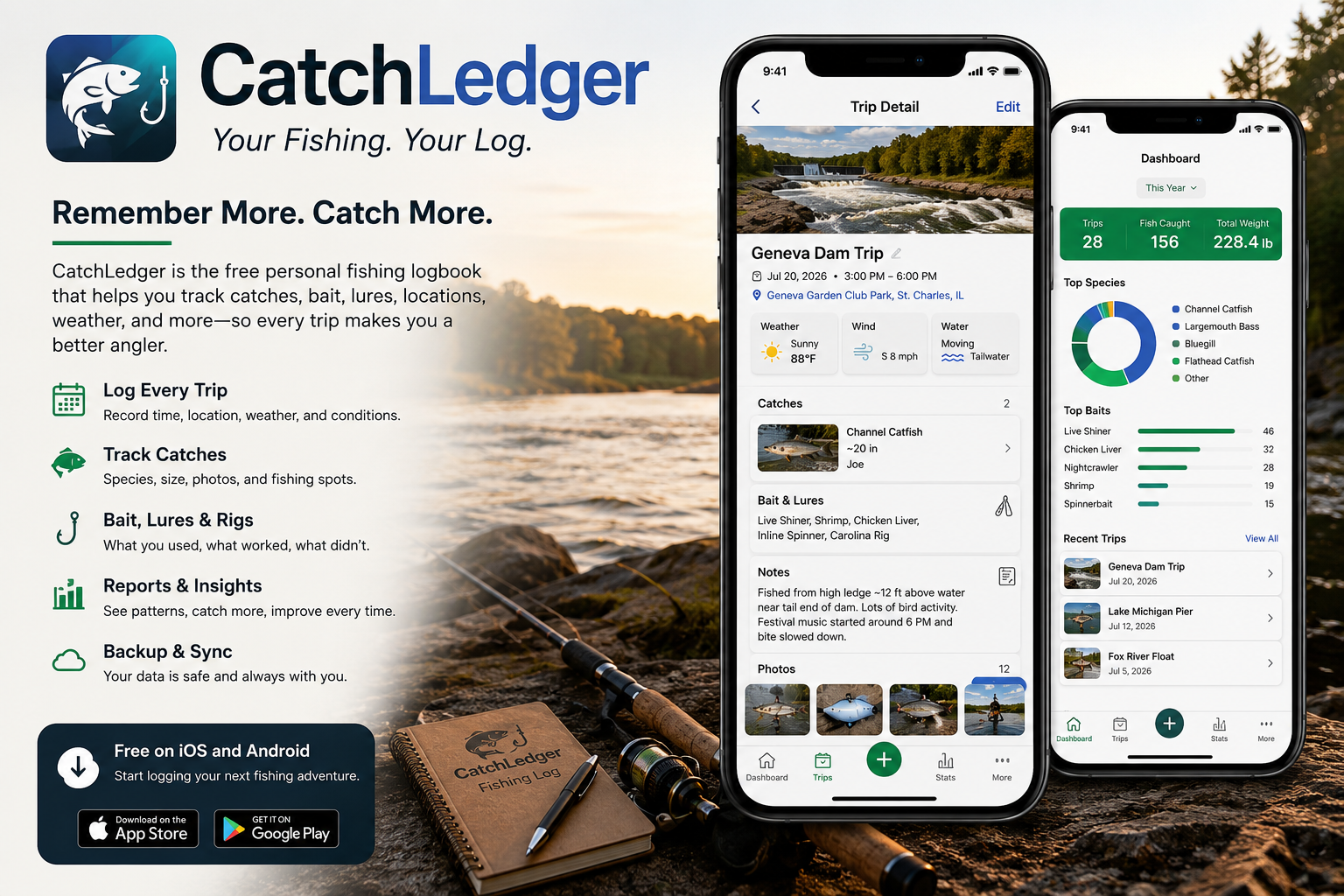
That is the whole reason I use CatchLedger. It is a free personal fishing logbook where I can record the bait, the rig, the weather, the water, the location, and a few notes while the trip is still fresh.
The best fishing log app is not the one that only celebrates your trophies. It is the one that quietly holds the full picture, slow days included, so the details are there when you need them.
What I would log in CatchLedger from this trip
- Date/time: 3 PM to 6 PM
- Location: Public dam tailwater, high ledge on the shaded bank
- Weather: Hot, sunny, summer afternoon
- Water: Tailwater and current below the dam, ledge about twelve feet above the water
- Bait: Live shiners, shrimp, chicken liver
- Rigs and lures: Sliding Carolina rig, inline spinner, bottom rig
- Gear: Ugly Stik, cooler with ice, drop net
- Species targeted: Channel catfish, flathead catfish, bass, and other river fish
- Species caught: Two channel catfish by Joe, about twenty inches each
- Notes: Heavy bird activity; another angler landed a flathead nearby when we arrived; festival music started around 6 PM and the bite seemed to slow after; drop net was essential from the ledge
- Next time: Arrive earlier, bring extra live bait, fish the bottom rig longer, and log the exact current and water level if possible
Two minutes of logging, and the next time I stand on a similar ledge I will know exactly what worked and what to change.
Why the trip was still a win
I did not catch a single fish. And it was still one of the better afternoons I have had all summer.
I watched a friend with twenty years on the water put on a clinic in live-bait catfishing. I got to work a drop net and land fish from a twelve-foot ledge. I learned that live shiners beat my prepared baits on this stretch, on a hot day, and I have a theory about festival noise that I can test next time.
My friend got photos with a very agreeable Chihuahua, we sat in the shade with cold drinks, and I took home a channel catfish that Joe caught and I kept. There is real value in a day like that, the friendship and the time outside as much as the fishing itself, and none of it depended on me filling a stringer.
Getting skunked is not a failed trip. It is a data point with good company attached.
Conclusion
Dam tailwater fishing gave me current, oxygen, live bait, local knowledge, a drop net, and a lesson about noise and timing, all in one hot summer afternoon. If you fish below a dam, pay attention to the same things: where the current seams form, what the fish are actually eating, how you will land a fish from where you are standing, and what changed when the bite turned off.
Then write it down.
CatchLedger is a free personal fishing logbook app for iOS and Android that helps anglers track catches, bait, rigs, weather, water conditions, photos, and trip notes. If you want to remember what worked at spots like this without giving away your favorite water, log the details while they are still fresh. The afternoon I just described is already fading in my memory. The log will not.
Comments
Have a fishing log tip, bait note, or tracking habit? Share it below.