Fishing logbook guide
Why Keeping a Fishing Log Helps You Catch More Fish
Learn how a fishing log helps anglers track catches, bait, weather, water conditions, slow days, and fishing patterns so each trip teaches you more.
A fishing log helps you turn individual trips into a record you can learn from. Instead of trying to remember every bait, location, weather change, and bite window from memory, you keep the important details in one place.
Most anglers remember the big moments. They remember the biggest fish, the hard fight, the friend who was there, or the spot where everything finally came together. What fades faster are the small details that made the trip work: the bait, the time of day, the wind direction, the water clarity, the rig, the depth, or the exact stretch of bank where the bite started.
That is where a fishing log becomes useful.
A good fishing log does not have to be complicated. It does not need to feel like homework, and it does not need to turn fishing into a spreadsheet. Even a short note after each trip can help you notice patterns, compare conditions, learn from slow days, and make better decisions the next time you go out.
The goal is simple: fish, record what happened, review what you learned, and improve over time.
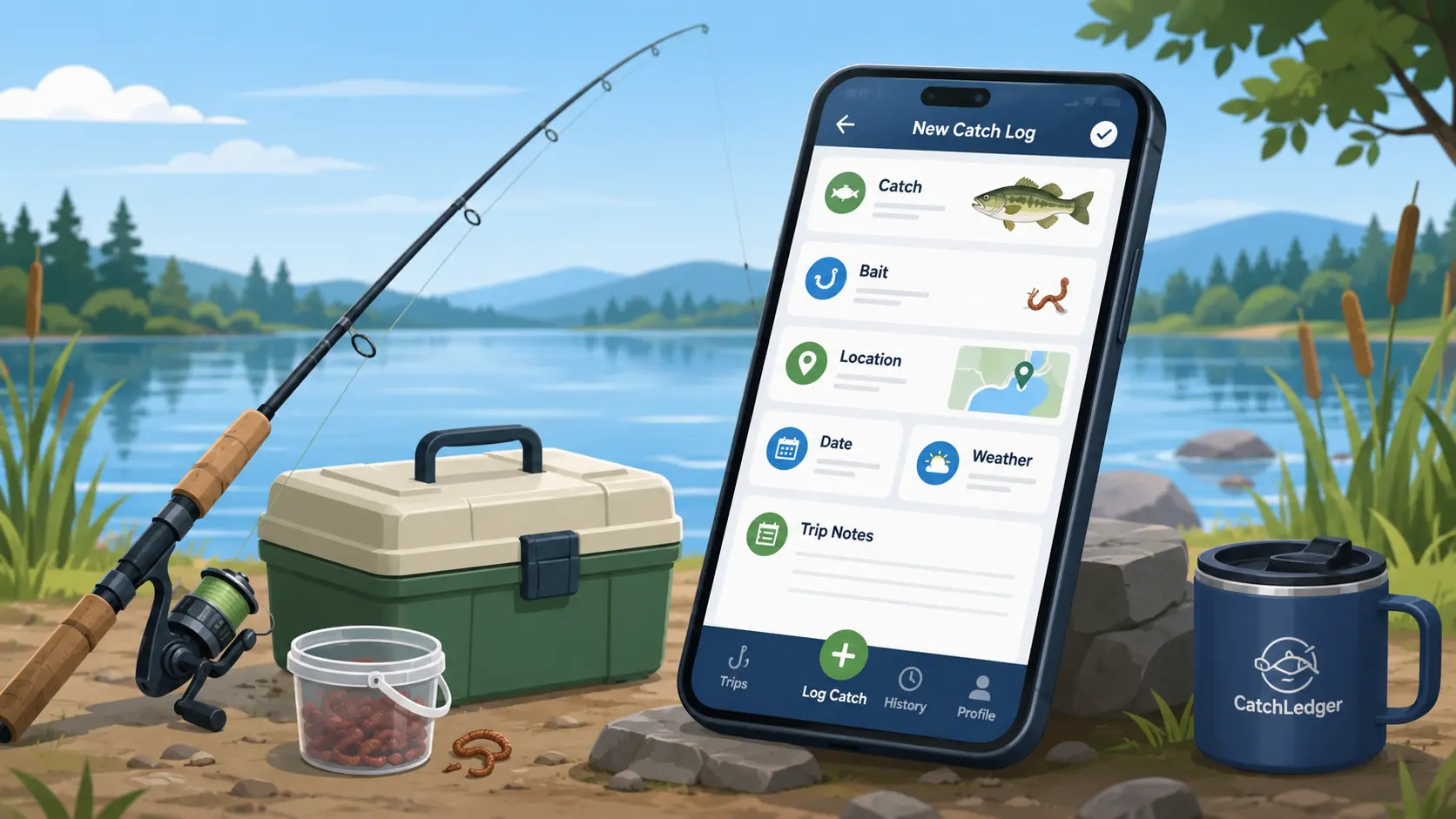
Your memory gets better when you write things down
Memory is useful, but it is not perfect. After a few fishing trips, the details start to blur together.
You might remember that you caught carp on corn, but forget whether it was canned corn, flavored corn, or a pack bait setup. You might remember that the catfish bite picked up in the evening, but forget whether the water was rising, muddy, calm, or cooling down after a hot day. You might remember the lake, but not the exact bank, current seam, weed edge, bridge, or drop-off.
A fishing log protects those details while they are still fresh.
When you write down the basics after a trip, you create a record that your future self can use. Weeks later, when you return to the same water, you do not have to start from zero. You can look back and see what worked, what failed, and what conditions were different.
This is especially helpful if you fish multiple locations. Without notes, it is easy to mix up which bait worked at which pond, which time of year was best on a certain river, or which shoreline produced fish after rain. A fishing journal keeps those memories organized.
A fishing log turns random trips into useful history
One fishing trip can feel random. You try a spot, use a bait, catch fish or do not catch fish, and go home.
A fishing log turns that single outing into part of a larger history.
Over time, your catch log becomes more than a list of fish. It becomes your personal fishing database. It can show you when certain species became active, which areas produced best, which bait worked in specific conditions, and which setups were worth using again.
That history is valuable because fishing is full of variables. Season, water temperature, rain, current, pressure, sunlight, cloud cover, baitfish activity, and angler pressure can all change the bite. You cannot control all of those factors, but you can record them and look for patterns.
The more consistent your notes are, the easier it becomes to see what is actually happening.
Patterns become easier to spot
One catch can be luck. Several similar catches under similar conditions may be a pattern.
When you track species, bait, location, weather, and water conditions, your fishing log can help answer practical questions:
- Which spots produce during spring, summer, fall, or winter?
- Which baits work best in stained water?
- Do certain areas fish better with wind blowing into them?
- What time of day has produced the most bites?
- Which conditions usually lead to slow trips?
- Which locations are worth revisiting?
- Which rigs or presentations actually helped?
You may not see these answers immediately. A fishing log becomes more useful as it grows.
The same bait does not always mean the same result
A fishing log also helps you avoid assuming that one good method will work the same way every time.
For example, last summer I caught a 23-inch carp at a lake using a homemade carp bait mix with corn, cornmeal, red Jell-O, corn syrup, and oats. It was a hot day, early in the morning, and the carp were active enough that the bait and spot came together.
This spring, I tried a similar approach in the same area and got skunked. The bait was familiar, the spot was familiar, but the conditions were not the same. It was cooler, windier, and the carp school never really showed up.
That is exactly why a fishing log matters. If I only wrote down “corn mix caught carp,” I might blame the bait when it fails later. But if I track the season, temperature, wind, time of day, and fish activity, I can see the bigger picture. The method may still be good, but the timing, weather, or seasonal pattern may be wrong.
A fishing log helps separate the bait from the conditions around the bait.
The same is true for catfish, bass, panfish, trout, or any other species. Patterns become easier to notice when your fishing history is written down instead of scattered in memory.
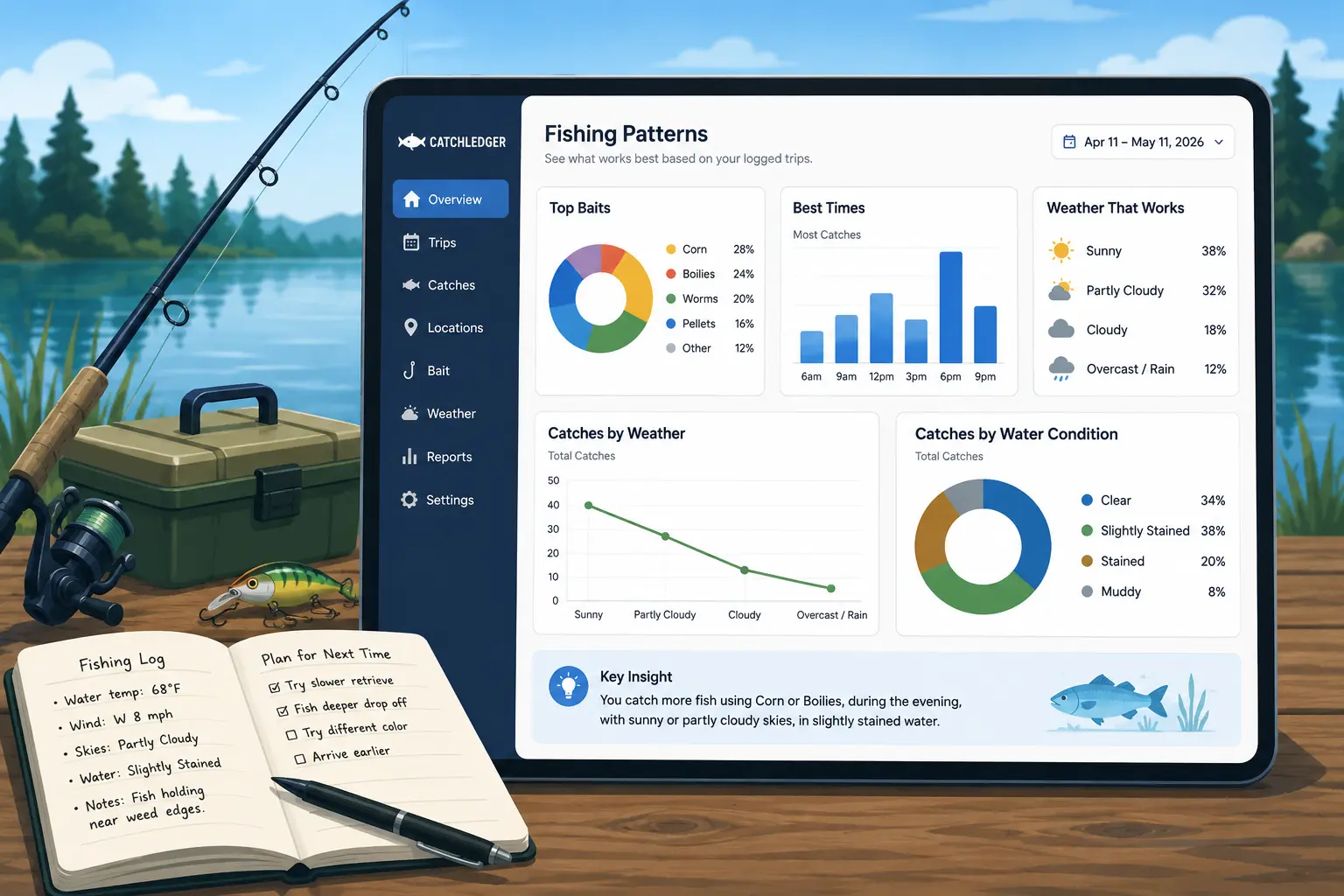
You learn which details actually matter
At first, you may not know what to track in a fishing log. That is normal.
Start with the basics:
- Species
- Date
- Time
- Location
- Bait or lure
- Rig or gear
- Weather
- Water conditions
- Notes
- Photos
After a while, you will learn which details matter most for the way you fish.
A carp angler may care more about bait, chum, pressure, water temperature, and whether fish were visibly feeding. A catfish angler may care more about bait type, current, time of night, river level, and structure. A bass angler may care more about lure color, cover, retrieve speed, depth, water clarity, and seasonal pattern.
The point is not to track everything forever. The point is to build a habit of recording useful details so you can learn from them later.
Your fishing log should serve your fishing style.
Slow days become useful
A blank or difficult trip can still teach you something. In fact, slow days can be some of the most useful entries in a fishing journal.
If you only record successful catches, you miss half the story.
Logging slow days helps you compare what did not work with what did. Maybe the water was colder than expected. Maybe the lake was muddy after rain. Maybe fish were present but would not chase fast-moving lures. Maybe you fished the right bait in the wrong location. Maybe the spot was too pressured. Maybe the wind made one bank unfishable but pushed food into another area.
Those notes can save time later because they remind you what to adjust.
A slow day does not have to be a wasted day. It can become a reference point. When you look back, you may realize that a certain spot rarely produces under specific conditions. Or you may notice that you kept leaving too early before the bite window started.
A fishing log helps turn disappointment into information.
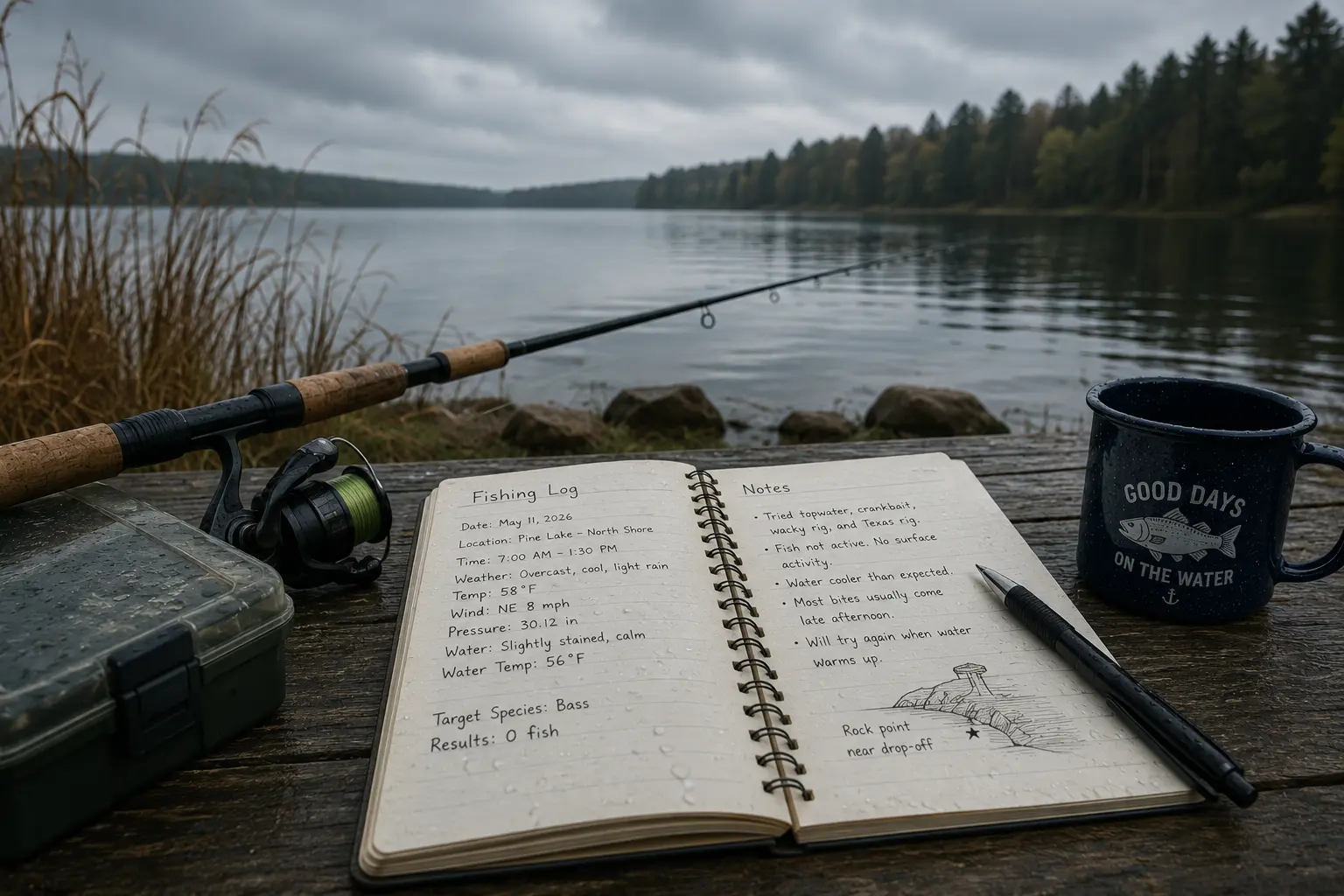
You can test changes instead of guessing
A fishing log makes experimenting easier.
If you switch bait, change hook size, try a new rig, move to a different depth, or fish a different section of the bank, write it down. You do not need a scientific experiment for every trip, but you do need a record of what changed.
Over time, your notes can show whether a change helped or whether the conditions were probably responsible.
For example, if you try a new bait once and catch a fish, it is tempting to believe the bait was the reason. But if your fishing log shows that the same area, same weather, and same time window produced fish before, the bait may not be the only factor.
On the other hand, if one setup keeps producing across different trips, locations, and conditions, that pattern becomes harder to ignore.
A fishing log makes your decision-making more intentional. Instead of guessing, you start testing.
You waste less time on repeat mistakes
Without a fishing log, it is easy to repeat the same mistakes.
You may return to a spot that only produced once under very different conditions. You may keep using a bait that worked in spring but has not worked since. You may forget that one shoreline is difficult after rain, or that a certain access point is too crowded on weekends.
A fishing log gives you a record of those lessons.
Before a trip, you can review your notes and ask:
- What worked here before?
- What did not work?
- What conditions were similar?
- What should I try differently this time?
- Is this spot worth fishing again today?
That kind of review does not guarantee a catch, but it gives you a better starting point.
Your favorite trips are easier to remember
A logbook is not only about catching more fish. It is also a record of places, people, photos, and moments you may want to revisit.
Some fishing trips matter because of who was there. Some matter because of the weather, the scenery, the effort, or the story behind the catch. A short note about who you fished with, what the morning looked like, or why a catch mattered can make an entry meaningful long after the details would normally fade.
Photos help too. A fish photo is useful, but so are pictures of the water, bait, rig, shoreline, or conditions. When those photos are connected to notes, they become part of the story instead of getting lost in your camera roll.
A fishing journal can help you become a better angler, but it can also help you remember why you enjoy fishing in the first place.
A fishing log is useful for bank fishermen too
Some anglers assume fishing logs are only for tournament fishermen, boat owners, guides, or people with expensive electronics. That is not true.
A fishing log can be especially useful for regular bank fishermen.
If you fish from shore, you often work with limited access. You may not be able to move freely across the entire lake or river. That makes location notes, weather, water level, and timing even more important.
For example, if a certain park pond produces at sunset but feels dead in the middle of the afternoon, that is worth recording. If one riverbank fishes better when the water is low, that is worth recording. If carp show up near a shallow flat only after the area has been quiet for a while, that is worth remembering.
You do not need fancy gear to benefit from a fishing log. You just need useful notes and the habit of reviewing them.
Keep your fishing log simple enough to use
The best fishing log is the one you keep using.
If you make the process too complicated, you will stop. After a long day outside, most anglers do not want to fill out dozens of fields. That is why your log should start simple.
A good basic entry might include:
- What you caught
- Where you fished
- What bait or lure you used
- What the weather and water were like
- What you noticed
- What you would try next time
That is enough to build a useful fishing history.
You can always add more detail later. If you discover that water temperature, moon phase, rig type, or hook size matters for your fishing, start tracking it. If a field does not help you make better decisions, do not force it.
Consistency matters more than perfection.
How to use your fishing log before the next trip
The real value of a fishing log comes when you review it.
Before your next trip, take a few minutes to look back at similar outings. Search your memory and your notes for the same season, same lake, same river, same species, or same weather pattern.
Ask yourself:
- Where did I catch this species before?
- What bait worked last time?
- What time of day was best?
- Were the fish shallow or deep?
- Was the water clear, stained, high, low, warm, or cold?
- What did I wish I had tried?
This turns your fishing log into a planning tool. You are not just recording the past. You are using the past to make a better plan.
Start simple and stay consistent
You do not need years of data to benefit from a fishing log. Start with your next trip.
Write down the basics while they are still fresh. Add a photo if you have one. Include one honest note about what worked, what failed, or what you would try differently.
After a few trips, review your entries. After a season, compare them. Over time, your fishing log will become more valuable because it reflects your own water, your own habits, and your own experience.
That is what makes it different from generic fishing advice. A fishing log teaches you from your own time on the water.
CatchLedger is a free personal fishing logbook app for iOS and Android that helps anglers track catches, bait, species, notes, photos, and fishing history. Use it as a simple place to remember each trip, review your fishing patterns, and learn from your own time on the water.
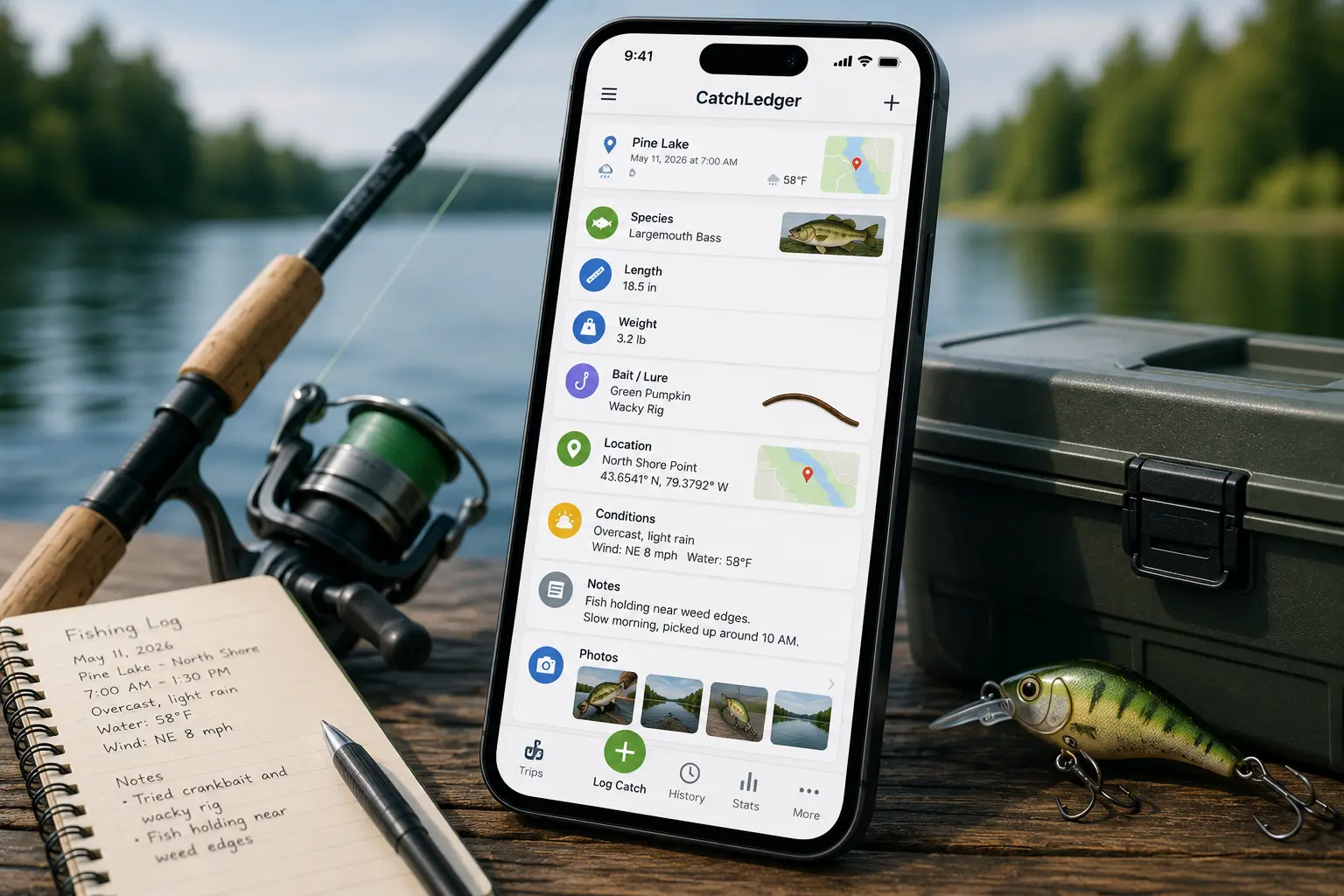
Comments
Have a fishing log tip, bait note, or tracking habit? Share it below.